Showing posts with label audio books. Show all posts

Sunday, October 24, 2010

The Eternal Savage

No, this is not about my son, who has come home from college for the weekend. Rather it is the name of a stand-alone book by Edgar Rice Burroughs, most famous for his pulp-era science fiction series such as John Carter of Mars, Pelucidar, the Venus series, and, of course Tarzan. My database reveals that this is the 32nd book I've read by this author, making him my 5th most read author. Of course, most of those books (all of them?) are fairly thin paperbacks at around 175-225 pages each. I read most of these books when I was a teenager, helping to launch my interest in Science Fiction, even though there really is very little "science" in them.

I acquired this book recently, spotting it at the used book store in the library where I frequently find older novels from "my" authors. It's been years since I've read an ERB and I was hoping it would stand the test of time, as in my own maturity. I've been afraid to re-read any of these books for fear they would fail that test. I'm sorry to report that The Eternal Savage didn't exactly relieve those fears for me. It had a hokey plot, in my opinion, about a caveman-era fellow named Nu, Son of Nu. He is in love and trying his darndest to win the hand of Nat-Ul as his mate. While hunting the most ferocious beast of the age, an earthquake strikes, causing a cave-in, trapping Nu inside. Cut to "present" day where an American girl, Victoria Custer, has gone to Africa to visit the Greystoke ranch (Tarzan, for the uninformed). It turns out that Nu has awoken in these modern times and spies Victoria, and thinking her to be his very own love, Nat-Ul. Another earthquake sends those two back to the Stone Age where Victoria turns out to be that same Nat-Ul. All of that just serves to set the stage for most of the book that follows. Much perilous adventure insues finally culminating in one final unexplained time-travel scene.

Of course, I don't expect great literature from these books but rather I expect pulp fiction which is what I got. It did remind me of lots of what I read in those teenage years but it didn't serve to keep me turning page after page. Rather it felt like a chore to plow through the predictable action sequences and jaw-dropping incredulity at the time-travel plot machinations. But still...there's enough nostalgia-related story telling here to make me plunk down my 75 cents if I see another ERB at the library book store.

Monday, October 4, 2010

Peter and the Secret of Rundoon

I just love going back to this Peter Pan series by Dave Barry and Ridley Pearson. Peter and the Secret of Rundoon is the third book in what I think is a 4-book series that is a prequel to the events in the classic Peter Pan story by J.M. Barrie. As popular as these books are, however, I can see there being more of them still to come.

Essentially, this series describes Peter's back story. Things like how he is able to fly, how he meets the people who will become Wendy's parents, how he develops relationships with the Indians of Mollusk Island, and the mermaids there, etc. We also learn about the back stories of other major characters such as Captain Hook, as well as how shadows work, and most importantly, what is the origin of "Starstuff", that strange substance that makes things fly.

But what's really great about these books, is that they are clearly in the YA market but they certainly do not simplify or otherwise dumb down the plot. This is fast paced, exciting adventure story telling with lots of edge-of-your-seat thrills but also with a good dose of characterization. The language style is pleasant to read and the plot is full of imagination. Just what a good book needs!

Thursday, September 30, 2010

The King of Torts

The King of Torts is the 10th book I've read by John Grisham. I suppose that makes him one of "my" authors although he has his share of let downs. Ever since I read The Firm years ago, I've looked for that magic once more but so far they've always seemed to fall a tad short.

I'm still not exactly what to make of this one. It is one of the better ones of Mr. Grisham's works that I've read, despite the nit picking that I'm about to do. It's a page turner for sure and I kept reading way past my bed time. That has to be a good sign right? Mr. Grisham does have a way of writing page turners; his language is for the common man, his chapters are fairly short so it's easy to think, "just one more chapter." * * SPOILER ALERT ** Sorry about this spoiler but its difficult to discuss this work without it. This novel could easily be classified as a tragedy in that we watch young attorney Clay Carter rise from a humble life in the Public Defender’s Office in Washington DC to become the newest "King of Torts", suing huge drug companies and others on behalf of wronged victims...only to have his empire crash and burn around him at the end. * * END SPOILER * *

As I said, it's a page turner but I do have some issues with the novel. The characters (particularly the protagonist) didn't always respond and behave the way I expected based on the first third of the book. In other words, I had come to know him pretty well through the various scenes and see how he reacts to events. But occasionally he does things completely out of character, yanking me right out of the narrative. Coupled with that, a couple of times I felt like the author was not treating me, the reader, with respect. I'm not a lawyer but in the course of the novel, we get a good dose of what tort litigation is all about and how it works, at least for a layman's perspective. But when a technique served well in the first part of the book, and the protagonist was well satisfied with the results, he tried it again and for no apparent reason it didn't fly the next time. It's as if the author ignored the investment the readers would make with the characters in order to make sure the plot worked as he wanted. As an example, there is one crucial court drama happening in the background during the final third of the book. * * SPOILER ALERT ** It's crucial to the plot and to what happens to our protagonist. We, the reader, along with the protagonist are led down the path of just how great it's going for our side, how amazingly the lawyer is skewering the opponent’s expert witnesses, how the jury is eating it up, and when the jury comes back with the verdict...we lose. That's it. No explanation. I know you can just never really tell with a jury but it seemed contrived by the author to disrespect the reader in order to get the ending he wanted.  * * END SPOILER * *

Yes, I am being hard on Mr. Grisham. But I'm sure his bestselling book sales will withstand my criticism just fine. And I expect a lot from him. The book was still fun to read and I'll keep reading him (I have at least 3 more on my shelves). But I'm still hoping for that great one.

Monday, September 20, 2010

Stars & Stripes Triumphant


This is the third and final entry in Harry Harrison's alternate history trilogy set during the 1860's. The first book, of course, set up the notion of the American Civil War being interrupted by a British attack on New Orleans, leading to the Americans re-uniting against a new common foe. Having successfully defended itself, the US follows up in the second book by diverting another British attack through Mexico, aimed at the American's soft underbelly by assisting the Irish to gain their independence. With a threat so close to her own homeland, the British have to pull back their resources from Mexico to defend its own shores. Now comes the third book.

This time around it very much seemed as if the author had a bone to pick with the British. He writes his British characters with, at best, unenlightened military minds, and at worst, as absolute buffoons. The Americans can do no wrong, militarily or politically. They use advancements in technology to great advantage and every battle in the entire book goes exactly as planned, leaving the British generals, admirals, and political leaders, (and especially Queen Victoria), to blunder about, dithering about how dare the British Empire be subjected to this. General Sherman takes center stage in this third book, leaving Abraham Lincoln to be just a kindly old uncle figure. Generals Grant and Lee and Admiral Farragut all participate in the invasion of England but they remain mostly offstage. Invasion of England? That's right. In response to the British Prime Minister, Lord Palmerston's inexplicable decision to plunder American cargo ships, Lincoln decides to put an end to this once and for all. I won't provide spoilers but let's just say that I can't imagine any British citizen today reading this and enjoying it. General Sherman's battle strategy is well laid out and makes lots of sense but it does rely on his enemies to do everything exactly as he suspects...which they do, of course. There is never any real doubt as to how it will all end, especially given the title of the book.

Having said all that, the book is an easy read...

Thursday, July 1, 2010

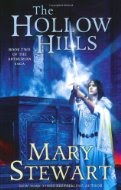
The Hollow Hills

I had been reading The Hollow Hills by Mary Stewart, the second book in her acclaimed Arthurian saga so I decided I would take it along on my trip to my son's 2-day college orientation.  It was a good choice as it certainly gave me something to do during the down times in the evening.  I had hoped to have more down time between lectures to read on it but there wasn't too much time.  Instead I skipped a couple of whole sessions on such intriguing subjects as how to handle the stress of your child leaving for college.  I think my wife and I have that under control...thus a bit more reading time.

The only bad thing about bringing this book along on the trip was that it's a great looking trade paperback and I had hoped to keep it looking nice for my bookshelf.  I almost made it...except for a leaky water bottle on the very last session.  Not too bad though, only a small section at the bottom of the last 20 pages or so now has that water/wrinkle look.

The book itself was mostly very good.  A few sections dragged a bit.  I've read quite a few versions of the Arthurian legend including those by TH White, Bernard Cornwell, and Stephen R. Lawhead.  Still on my shelf is Jack Whyte's huge 8 volume set which probably won't get read for at least 5 more years.  I like Ms Stewart's take on it though, fairly straight-forward story with lots of political intrigue.  Merlin is her narrator which is as it should be in my opinion.  Who else really knows everything that is going on here?  Looking forward to number three in the series, later this year.

Wednesday, March 3, 2010

The Successor

I've completed my latest audio book, The Successor by Stephen Frey.  Last year I listened to the first in this series starring Christian Gillette, a business mogul who becomes the leader of Everest Financial Capital, one of the largest private equity firms in existence.  That first book was filled with the tension surrounding his rise to power, but also many thriller aspects such as attempts on his life by rival power seekers.  It was a true "business thriller". 

This book is the fourth book in the series and possibly the last.  Mr Gillette has now been a powerful man of finance for many years now and in his mid 50's.  He has successfully raised absurd amounts of money for his clients and shared the vast wealth with his partners.  He has now been tapped by the US President to go to Cuba and, due to rumors of Fidel Castro's death, secure the future of American interests as Cuba joins the global marketplace.  I found the plot to be disjointed, however, and I believe Mr Frey missed the mark this time.

The business aspects of this one were mostly non-existent, with the protagonist having turned over most of the responsibilities of running the firm to Ms Allison Wallace.  Its very obvious from early on that Allison would become the "successor" as well as his love interest but it seemed Mr Gillette was the last one to figure it out.  The thriller aspects of the novel were left to the very end, added, it almost seems, as an afterthought.  The major meat of the novel instead focuses on Mr Gillete's mid-life crisis and his falling for a young 22-year old, who we readers figure out at the beginning is an actress, introduced in the very first scene.  When the author discloses that "ah-ha" moment of who this 22-year old really is, I couldn't believe he expected me to not have figured that out long before. 

I think the author had a trap to climb out of: he had a protagonist who, in the first three books had risen to such powerful heights that he had no more room for growth.  I think he tried to refocus his goals and take him in a different direction but instead he ended up thrusting him into an improbable scenario and then didn't follow through with a believable plot. I am hopeful Mr Frey will put this series to rest and begin anew.

I won't be doing any more audio books for a while.  I have reached the end of my Air Force career and will be retiring after 20 years of service.  In fact, at this point I have only 8 more days of actual work and thus, not enough time to get an entire audio book completed during my commutes.  While I have an ideal future planned that involves staying at home and working on my hobbies (reading, writing, watching movies, and playing computer games) my budget requires me to secure an actual income-producing job.  If I manage to land one in this economy and still have a reasonable length of drive to and from work I will re-enter the audio book realm.  Until that happens, I will miss them.

Wish me luck.

Saturday, February 6, 2010

Prior Bad Acts

I've completed another audio book, Prior Bad Acts by Tami Hoag.  As usual, I selected this one from the library because it was by an author whose name I had seen time and again and yet had never read.  My research indicates Tami Hoag got her start in romance novels but later turned to thriller novels and has since had 13 best sellers.  Thriller novels are usually a good choice for my audio book habit because their very nature makes the plot easy to get back into each and every time I start it up again.  Since I only listen to these when I travel to and from work, that's a key element.

The plot surrounds a Minneapolis judge, Carey Moore, who hands down a decision that prohibits the introduction of evidence about a murder committed by an accused serial killer with numerous prior crimes.  She feels the suspect's prior bad acts are not relevant to the murder of the moment.  But then the accused escapes from custody and shortly thereafter the judge is assaulted and then later, kidnapped.  All evidence points to the escaped serial killer but of course that would be too simple and thus the real mystery of whodunnit.  The novel is a "police procedural" style mystery with lots of methodical detective work by the main character, detective Sam Kovac.  There are also several subplots which serve to drive the story forward.

Unfortunately, I have a tendancy to pick audio books that are part of a series and I hate not starting at the beginning.  I wish the audio book makers would disclose such information on the outside cover; it would sure come in handy.  This one turns out to be the third featuring the two main characters and it was evident throughout the story that I had missed out on some important backstory.  As a result the novel fell a little flat for me, especially in the beginning when I was trying to get a handle on who was who.  The characters just didn't come fully to life the way I prefer.  I don't blame the author for that so much as the audio book people.  As such I don't really consider this a fair test of Tami Hoag novels so will probably have to try another in the future.

Monday, December 28, 2009

The Strong Shall Live

No need to rehash the stories in this marvelous collection of western short stories by the immortal Louis L'Amour.  I've blurbed on my blog (blog-blurbed?) each time I finished a story in The Strong Shall Live so my thoughts are already posted.  All except the last one, "Bluff Creek Station."  That story is the perfect story to finish off the book; whomever selected the order of the stories is to be commended.

"Bluff Creek Station" is one of the shortest of the stories in the entire collection and yet it is one of the most inspiring.  It begins with the main character knowing he is soon to die, shot through the spine by Indians raiding the stage coach station.  His only purpose in living at this point is to warn the stage that is due in to the station shortly, striving to live just long enough to fire off his shotgun as a warning that Indians still lay in ambush.  His thoughts while he waits and as numbness sets in throughout his limbs are poignant indeed.  This is excellent writing and definitely keeps you on the edge of your seat for the few minutes it takes to reach the end.

I've said before that Louis L'Amour has two reputations: one as a hack western formula writer who churned out short book after short book for years and so was obviously a "bad" writer.  I know personally of some people who dismiss him as a horrible writer simply because there are so many of his books on the book store shelves.  Obviously he can't be any good.  Of course, they have never tried a single one; they choose to let their elitism keep them from enjoying a good reading experience.  Others have said that his writing is "authentic" and allows the readers of today a glimpse into the real west of the later 1800s.  I probably fall somewhere in between but I've read enough to know that he isn't just a western writer, having written all sorts of adventure books from the WWII era all the way back to the stoneage.  He puts a lot of real history in his stories.  His biography makes it clear that even though he was a self-taught man he did an enormous amount of research for his stories; walking the hills and valleys where they take place.  A quick check of my database reveals that this book is the 61st of his that I've read.  That puts him at number 2 on my all time list and I can honestly say that I've enjoyed all but perhaps 3 of them.  That's a pretty good record.  While I don't pretend to say he is a "great" writer, he certainly fits the description of an enjoyable writer.  And when all is said and done, that's a pretty good epitaph.

Coming soon: my end-of-the year "TopDragon" annual award winners.  Stay tuned!

Monday, December 21, 2009

The Hot Kid

Elmore Leonard is a writer after my own heart.  He started with westerns and then turned to crime fiction, becoming one of the best selling crime fiction writers of all time.  When I saw the audio book, The Hot Kid on the library shelves this time, I just couldn't pass it up because I knew I'd be in for a treat.  I also needed a relatively short book this time so I could complete it before the end of the year.  It was so good though that I made excuses to go driving just so I could hear more of this story, lol.

The Hot Kid is Mr Leonard's 40th or 42nd book (I've seen references to both) and was published in 2005.  Boy, he sure hasn't slacked off.  I would guess he is probably best known for good guy characters that are right on the edge of being not-so-good.  Many people seem to like the movies that have been made from his books like "Get Shorty," and "Out of Sight" but I didn't care for them nearly as much as the novels themselves.  (Although I did like "3:10 to Yuma" in it's latest incarnation, adapted from his short story written in 1953). Here, he turns back the clock just a little and sets this novel in Oklahoma during the 1930's mobster era.  Right away that sounds like an unusual setting.  As always, his characters use dead-pan humor consistently, winning the reader over with their charm, whatever their ultimate intentions may be. 

The plot deals with two men at opposing ends of the law-abiding spectrum.  Jack Belmont is the son of a Tulsa oil wildcatter and pulls every dirty trick in the book to blackmail and extort money from his own father.  From there he goes on to organized crime and strives to rival Pretty Boy Floyd in evilness. Going up against him is a deputy US Marshall, Carl Webster, who has gained a reputation as a fearless lawman after killing several notorious mobsters.  Their confrontation is classic and truely a delight to read.  For a shorter novel, the characters are remarkably well developed and the plot was not predicatable in the least; just the ticket for a drive-time audio book.  I especially enjoyed the way Mr Leonard included the young adulthood of both characters and showed how they came to be the way they are.  If you haven't read Elmore Leonard in the past, it's never too late to start.

Monday, December 7, 2009

The Grapes of Wrath

I completed the lengthy audio book of John Steinbeck's The Grapes of Wrath over the weekend. I had selected this audio book for several reasons: 1) I always feel like I need to read more "classics" and this one was handy at the library, 2) I had read Of Mice and Men many years ago and enjoyed it pretty well, and 3) this is supposed to be one of the greatest American novels of all time. In fact, many people would put it number one on their list. And in case you didn't know, it won the Pulitzer Prize in 1940 and the Nobel prize for Literature in 1962.

Many times I find the "classics" to be dull and even just plain boring. Not so this time although it is not an easy read and I would say it is usually depressing. This is truly an American story. We follow the Joad family for about nine months during the Dust Bowl/Great Depression days as they decide to uproot their family from Oklahoma where they have lived for generations as sharecroppers, and follow them to California as they search for a better life. Along the way they encounter numerous obstacles, many of them very dangerous, and we get an upfront and close personal view of their day-to-day lives. Once they finally reach California, they find it's not the paradise they have heard about and their daily struggle continues.

I believe this book can be read on several levels. The more scholarly types like to hold this book up as a classic example of the way one family has to exist in a system that favors the powerful land owner vs. the farmers and laborers. It's certainly true that Steinbeck's method of writing this book supports that view. He intersperses each lengthy chapter with a shorter "big picture" description of what is happening in the world at that time. The California scenes, especially, are poignant examples of the plight of migratory farm workers, a subject which Mr Steinbeck was almost obsessed. Some people criticise the book as too "socialistic" or even "communistic" but I see it as a reflection of the times in which it was written and in the timeframe it portrays.

While I can very much appreciate this novel on such a grandiose scale, I also appreciate they way the characters are written. I think most regular readers of this blog will know that characterization is the number one mark of a great novel for me and this one has it in spades. The entire Joad family, especially Tom, Ma, Uncle John, and the former preacher, Jim Casy are fantastic examples of greatly written characters. Tom Joad himself is as important a character in American fiction as Holden Caufield and Jay Gatsby and only a notch below Huckleberry Finn himself. I worry that many students were assigned this book to read in High School and came away with a complete distaste for Steinbeck. Actually I worry about that for all sorts of "classic" books. But now that I have achieved some level of maturity (I can't believe I just wrote that) it is possible that I can appreciate the true worth of a book like this.

My next audio book will be...dunno. Depends on what I find at the library but it will have to be a shorter book than this so I can finish it before the end of the year.

Friday, October 16, 2009

The House of Thunder

I've completed my latest audio book. This time it was The House of Thunder, by Dean Koontz. It seems like I am reading a bunch of horror novels lately (not to mention haunted house stories) but that's just the way its worked out. I chose this particular book almost be default. I've been trying a new library that is closer to my work place, making it easier to pick up and drop off but turns out there are very few audio books there that aren't abridged. This was just about the only one I found that was unabridged, and since I've read quite a few Koontz novels before I felt pretty safe in my pick.

Having said that, Dean Koontz can be hit or miss for me. Happily, this one was one of the better Koontz novels I've experienced. I've read enough Koontz to realize that I tend to like his earlier stuff better so perhaps that is why I liked this one. Apparently this was first published in the early 1980's under one of Koontz' pseudonyms. And it's not a haunted house novel in the usual sense at all...more of a haunted hosipital. It has a cool premise and setup for a horror situation. The protagonist, Susan Thornton, wakes up from a coma (from an auto accident) with amnesia. At first her recovery experiences are pretty normal but soon she starts to hallucinate about hospital staff members being bad guys from a murder she witnessed 13 years ago, a murder that resulted in the death of her fiance. That progresses into even more strange happenings, some of a truly horrifying nature and Susan begins to question her own sanity. It's a cool setup for a horror novel because we, the readers, aren't any more sure of what's going on than Susan herself. We can really get into her position and suffer along with her as she tries to sort out fiction from reality. Is she really hallucinating? Is she crazy? Or is something more sinister going on. And because it's a Koontz novel, we can never discount the possibility that supernatural forces are at work here.

The narration was well done on the audio book which always leads to a better experience. They used two people, a male and a female to do the different parts so that helped suspend the disbelief. The resolution was a slight let-down for me as the novel itself changed from a horror novel to more of a spy/thriller story and Koontz does the former better than the later. But the plot was still smooth and the ending was comfortable. All in all an enjoyable "read".

F my next audio book: The Grapes of Wrath by John Steinbeck. No, I've never read it so I figured an audio format might be the only way I ever get this one done. And no, it's not abridged (went back to my old library) so I should get the full impact of one of the great classics.

Thursday, August 27, 2009

Day of the Dead


I finished my latest audio book this morning on the way into work. It was my first book ever by J.A. Jance and is called, Day of the Dead. I didn't know this when I picked it off the library shelves but it is the third book in a mystery series involving an Indian reservation in Arizona. That happens quite a bit for me when I pick up an audio book from the library...I don't have the ability to research to see if it is part of a series. But usually, with mysteries it doesn't matter too much.

JA Jance, on her own website, defines the difference between a "mystery" novel and a "thriller" novel. She says in a mystery, you don't know the identity of the bad guy(s) or whodunnit until the end and the joy is in solving the mystery. In a thriller, however, the reader knows who the bad guy(s) is/are up front, even if the main characters doesn't. This particular novel is billed as a thriller and, indeed, we readers get to see whodunnit near the beginning so I guess it fulfills her definition. In my mind though, a "thriller" also provides "thrills" and this novel just didn't do it for me.

Apparently I am not alone in that opinion as most reviewers tend to classify this one as one of the lesser liked novels by JA Jance. She seems to have a devoted following of fans who really love her tremendous output but they say everybody has a bad book now and then and this one is one of hers. The story itself is OK and I really like the overall premise of having the TLC (The Last Chance) as a privately funded organization that looks into unsolved crimes...cold cases...that the police force just doesn't have time or resources to look into. And I liked the protagonist, a retired sheriff named Brandon Walker as he takes on the case for the TLC. But the balance between the mystery solving, the thriller aspects of the bad guys, and the subplots about the various members and relatives of the cold case murder victim was way to heavily weighted towards the subplots. The bad guys, a husband and wife team of sexual predators/perverts, seemed to me to be cardboard cutouts of a 1970s era TV show crime drama...i.e. very one dimensional and not at all the monsters they should have been. There were a couple of scenes that were fairly graphic sexually and that seems to have turned off many of Ms Jance's devoted followers..apparently she doesn't do much of that in most of her books.

I probably owe it myself to try one of her other books, in one of her other series but at this point I am not anxious to do so. So many books out there and I'm not getting any younger...

Thursday, August 6, 2009

The Fountainhead


It's been quite a while since my last post about an audio book I've read (er...listened to). I had to look back to see that it was on June 17th. Well, that's because it has taken this long to finish my latest audio book, The Fountainhead by Ayn Rand. As I've mentioned before, I will often chose an audio book that is a "classic" because I don't read those all that often. This time, when I was at the library to make my choice, I found mostly abridged versions of books and I just won't read/listen to those if at all possible. If it's not presented the way the author wanted it, (and the editors and publishers and marketers and other assorted staff members that help to manufacture a book these days) then I don't want to read it. So even though this book was 26 disks long, I decided to give it a try.

26 discs! That's a lot of hours of listening to one story. It is truly a testament to the quality of a novel, as well as the reader and the production quality of an audio book, that it can keep your attention for so long. This novel did just that for me. I can honestly say this has been a wonderful experience.

I had always heard of Ayn Rand and I had seen her large major works at the book store, and I had even done a little research on her to see what all the hooplah was about her philosophy of objectivism. So I really didn't know what to think when I began this book. Would it read like a super-long essay with a thin plot spread over the top? Would it be a "preachy" novel? Could I even last through the first disk? I was prepared for almost anything except what I got which was a nicely developed story with wonderfully complex characters.

On the surface, this is a story about architecture and the men and women of that industry in early 20th century New York. But really it's about a handful of characters who represent certain archetypes that Ms Rand uses to codify her objectivism philosophy. Howard Roark is the perfect man in her philosphy, unwilling to compromise one iota for his art even if it means near starvation as an architect. He is indifferent to the opinions of others and therefore "the one who is as man should be." Peter Keating is "the man who couldn't be successful but doesn't know it." Unlike Roark, he patterns his art after others, rationalizing that if he does the same thing then he will also be successful. Ultimately he is passed by because he just doesn't understand the neccessity of originality. Ellsworth Toohey knows he will never be successful in the same vein and so becomes successful at destroying others. He is the "man who couldn't be and knows it." And then Gail Wynand is the "one that could have been." Rising from poverty to be a powerful media mogul, he chooses to try to control others rather than create for himself. I'll leave it to others to debate the relative merits of Ms Rand's philosophy but for me, the characters and how they interact are prime; a great novel is a great novel because of the writing, the setting, the characters, the style, the plot, etc. And this is a great novel.

Is it perfect? No, I don't think so, even if one ignores the underlying phiosophy and only looks at it from a novel writing perspective. There are long passages where one character spews forth their point of view, detailing their particular philosophy on the nature of what makes for a good society, or a good relationship, or even on the very nature of good and evil, etc. Some people say this is "stilted" dialogue and I concur. It just wasn't realistic.

The novel is broken down into four parts, one for each of the main characters. That section tends to have more of the story presented from that person's point of view but the overall plot is consistent and chronological. The plot itself is masterful and includes elements of revenge, intrigue, power plays, romance, and courtroom drama. The pacing is spot on, driving the plot towards its powerful conclusion. I highly recommend this novel, whether reading for sheer pleasure or for a launching platform for philosophical discussions.

I have a long 3-week vacation coming in September so I will need to ensure my next audio book selection is much less lengthy. (But no abridgements!)

Wednesday, June 17, 2009

Night Over Water


I've completed another audio book: Night Over Water by Ken Follett. Regular readers of this blog will know that I listen to an audio book back and forth to work every day, about a 30 minute commute for me one way. I selected this one from the library because I have read 4 or 5 Ken Follett novels so far and while some have been better than others, I have never felt that I've wasted my time.

This novel takes place in 1939 just after England has entered World War II. It's told from multiple points of view, all from people who will take a flight aboard a Pan-Am Clipper (a truly luxurious (and historically accurate) airplane in the second 2/3rds of the book. This is sort of like a "Murder on the Orient Express" set-up although more thriller than who-dunnit mystery. Passengers include business people, aritocratic families, a debutante, a film star, a petty thief, etc. They all have reasons for being on this luxury plane ride across the Atlantic, some of them because they want to be there and some because they have to be. The thriller/action part of the plot surrounds the lead engineer of the plane who is forced to sabotage it in order to save his wife who has been kidnapped by mafia types in America. They want to spring one of their compadres from on board who is being transported back to jail in the US. In the end it turns out to be much more complicated than that even and most of the characters that were unknown to each other at the beginning are involved together in the action at the end.

This is a well-plotted novel; the suspense builds as we make our way through the story and we get to see events from several perspectives. Mr Follett does a great job building his characters and even though there are quite a lot of them, it is easy to follow the action because we know them so well. And he does a fantastic job of establishing the atmosphere. The descriptions of the scenes and especially the dialog of the characters really brought me in to the era. Sometimes it was like I was watching a Humphrey Bogart movie. The only problem I had was not with the novel itself but rather the production of the audio discs I was listening too. The narrator did a good job of voicing so many parts but it seemed like the whole thing had been spliced together one sentence at a time. It made it sort of disjointed and it definitely interfered with the "Losing oneself in the story" aspect. Regardless of that, I thoroughly enjoyed this novel and rank it among the best of Ken Follett's work I have experienced so far.

Next audio book for me: Ayn Rand's The Fountainhead. Coming in at a cool 24 discs this one's going to take me to Thanksgiving to finish...

Friday, May 22, 2009

Bittersweet


I've completed another audio book, Bittersweet, by Nevada Barr. Followers of this blog will know that I have a fairly long commute to work each day and I like to listen to audio books (at least as long as my son isn't in the car...he prefers his iPod music). I pick out my audio books from the library, usually on a whim. Often I pick based on the quality of the case. That's not to say I am judging the "book" by its cover but rather I have borrowed several older recordings only to suffer through lots of scratches and skipping on the CDs so I would rather take my chances on the newer aquisitions.

I selected this novel because of the author, Nevada Barr. I have never read any of her work but have heard great things about her mystery series involving a park ranger. Supposedly, they are a "different" sort of mystery. Since this was a stand-alone book I thought I'd give it a try. Overall I can say Ms Barr impresses me as a writer. This is basically a western novel but definitely a "different" sort of western.

Ms Barr's word choice is superb. Her descriptions of the locale, the scenery, the very sounds and smells of each scene put the reader right there. Her characters are well rounded and react to their situations as real people would. They change and grow and evolve throughout the book and the reader grows with them. The emotions they go through are so real that we feel it too. Almost too real. The novel itself is bleak as can be and the overall experience was one emotional catastrophe after another. It centers around Imogene, a lady school teacher in rural 1800's Pennsylvania and Sarah, one of her female students. Through a series of circumstances they are forced to move to Reno Nevada and then once again to the middle of nowhere in Nevada where they manage a stagecoach stop. Sarah grows from a weak-kneed wishy-washy girl to a strong willed matron of the West. Along the way is one personal tragedy after another leading to what could be a rather depressing reading experience. If you don't like to read depressing novels then this may not be for you. However, Ms Barr's story-telling ability makes this more of a poignant work than just a novel of tragedy. The main characters overcome (or succomb to, depending on your point of view) rape, spousal abuse, being outcast from their homes, the death of an adopted child, the stigma of lesbian love, and of course the trials and tribulations of being women in the West during that era. But through it all is the experience of being there. It is a story of true love and the willingness to live outside accepted practices...and all of the consequences that are thereby inherent.

I'll be happy to try out her mystery series now and will expect a "different" sort of mystery than the formula series we see so often. Now...it's off to the library once again!

Tuesday, April 28, 2009

This Side of Paradise


I finished up my latest audio book on the drive in to work this morning. My last trip to the library resulted in a quick grab and go as I just didn't have much time to devote to browsing the shelves of audio books. I had read The Great Gatsby in High School, just as so many of us did and recall that being better than I had expected it to be. For some reason, then as well as now, the period of the 1910's - 1920's in America has never been very interesting to me, excepting perhaps World War One itself. So I grabbed This Side of Paradise by F. Scott Fitzgerald. I hoped it would give me perspective on what I remembered of his work before.

I always like to do a little research on books I read as well as their authors, particularly the classics. The first thing I discovered was that F. Scott Fitzgerald's full name is Francis Scott Key Fitzgerald and in fact, he was a distant relative of the author of the poem that became America's national anthem. Maybe that's well known but that particular piece of knowledge had somehow escaped me all these years. This book itself, was Fitzgerald's first published novel, and in fact, became a best seller and put him on the map. It is largely biographical. The story goes that he began writing the novel in Army training camp during WWI, but afterwards had to beg his lady friend, Zelda to come back to him. She agreed only on the condition that he finish the novel, publish it and become successful. This he did and the rest is history.

The novel itself is a coming of age novel wherein the protagonist, Amory Blaine never really does come of age. He is a child of privilege and thus has a condescending attitude toward most others, particularly women. He suffers from low self esteem but covers it up with glibness and sometimes arrogance but depite all of that, he is still a likeable character. He is very introspective and Fitzgerald spends a lot of time having Amory try to meld together the idealistic concepts of a Princeton student with the realities of early 20th century American life. Amory has several girlfriends during the course of the novel and it is through these foils that we see what makes Amory tick and how he grows. The story is written in several different forms, through prose, poetry, letters, and stage direction. That can be somewhat confusing when done in the audio format but I don't suspect it would be a problem in normal book form.

In many ways this could be considered a romantic tragedy. There are numerous similarities with the characterizations and style of The Great Gatsby and most people agree the later work is superior. It has been so long between experiencing the two novels that I can't say which I prefer. Both are classics and worthy novels to read. While I would choose neither to take with me to a deserted island, I am glad I read (listened to) this one.

Of course this means another trip to the library as soon as I can get there. Not a bad thing to look forward to :)

For those of you who follow this blog to find out what is happening with Sweden's world domination in my computer game, Empire: Total War, suffice it to say that I over-reached a bit. I was so smitten with conquering the rest of Europe that those pesky Frenchmen rebelled to such an extent that they rose again in the middle of my empire! Yes, the French Revolution happened all over again. And then parts of Germany did the same thing! My armies were spread so thin that it took me a couple of years (game time) to supress them again and it's costing me huge coin to keep them subdued. Did this sort of thing happen to Alexander?

Wednesday, April 8, 2009

Tooth and Nail


This morning on the way into work I completed my latest audio book, Tooth and Nail, by Ian Rankin. This was the first book I had read (or listened to) by Mr Rankin. I had picked it out of the library like I usually do...it looked interesting: a serial killer is on the loose, with the interesting characteristic that he bites his victims sort of like a werewolf. I've done a little research since then and have found that Ian Rankin is one of the top selling British novelists alive today. In fact Wikipedia, if you can trust it, says 10 percent of all books sold in Britain are written by Ian Rankin. Wow, that's impressive. I also discovered this book is part of a series of crime solving novels featuring Detective Inspector Rebus.

From the moment I inserted the first disc into my car's CD player and heard the fantastic British accents of the narrator, Samuel Gillies, I was transported to London where the majority of the plot takes place. Inspector Rebus is a Scottsman and the narrator is incredibly adept at portraying the various British and Scottish accents of the characters, helping the listener to keep track of who's who. In fact, the narrator might be too good for I often found myself admiring his skill as opposed to following the plot. As a result I often found my mind wandering a bit and having to jerk myself back to the tale itself.

But that aside, I enjoyed this novel. It's been quite a while since I've read a straight forward detective novel. The mysteries I've read lately tend to be more of the amateur sleuth variety, the ones where the protagonist is a "normal" person (i.e. not a professional detective, police force, etc.) and happens to find themselves in the midst of a murder situation. In this novel, I particularly liked the other major character, George Flight, who is Inspector Rebus' equivalent in London. They work together on the case and it was a pleasant switch from the typical modern day detective novel where the protagonist is forced to work around the local buffoonery and tolerate their incompetence. I wonder if future Ian Rankin novels include Flight or perhaps he may have his own novel or two. The serial killer mystery itself was quite engaging...I didn't figure out the culprit until it was revealed in the course of the story, and yet it was entirely logical. No doubt my wife would have figured it out before hand but she is smarter than me. Nevertheless, this is always a good sign for murder mysteries.

So today I will visit the library once again and see what strikes my fancy. Can't wait.

Friday, March 13, 2009

Play Dirty


I was introduced to the author Sandra Brown via an audio book that I borrowed from the library several years ago. She was and is a prolific author, with many novels to date, mostly of the sub genre romance thrillers. I tend to like thrillers of all kinds and since I'm not opposed to a little romance in the books I read I thought I would give her a try. That book was Envy and frankly, I really enjoyed it. Her style of writing seems well adapted to the audio book format and she has just enough twists and turns and suspense building to keep my interest through the 3-4 weeks that it takes me to listen to an audio book as I drive back and forth to work every day.

Five Sandra Brown books later I still enjoy them. I completed Play Dirty on the way into work this morning and it is no exception. It has an interesting premise that sets up the story: a star NFL quarterback has just recently been released from a 5 year prison sentence for gambling, throwing a key game, and other self-indulgent behavior. He is offered a deal to sire a baby for a wealthy corporate CEO and his wife who have picked him for his physical attributes. The CEO is in a wheel chair and can not sire a baby himself. The catch is, they aren't talking about invitro fertilization but rather...the old fashioned way. Of course that means, the CEO's wife and the ex con quarterback have to have sexual relations. This is just the setup and there are many more sub plots as well that lead us through the adventure.

While I enjoyed listening to this audio book, there were problems with it. The characters, to put it bluntly, just weren't likeable. That in itself can be OK, depending on the nature of the story but here, the author clearly hopes that we become sympathetic to the protagonist (the quarterback), hoping we come to believe he was just misunderstood. By the end of the novel we do get to see him in a better light but he is definitely a flawed chraracter. The other major characters I found to be very two dimensional though. Characters are supposed to grow in some fashion during a novel...better, worse, older, wiser...something. The CEO's wife for example, does grow but at such a breakneck pace that she is unbelievable. The coach, who is so bitter by the quarterback's betrayal 5 years ago that he can't see straight, makes a 180 degree turn at the end of the novel in the space of one paragraph. It seems to all be a bit too contrived.

Perhaps I am being too picky here. Afterall, I borrowed this audio book from the library to be entertained...and I was. I will borrow other Sandra Brown books occassionally as well because they never cease to entertain.

Monday, February 23, 2009

Note to Audio Book Manufacturers

My last audio book experience was less than pleasant. I had selected Dirty Money by Richard Stark. Like most of my audio book selections, I was trying a new author, and looking forward to the story. I read the cover blurbs thoroughly but nowhere was there any indication that this book was part of a series. In fact, it was part of a large series but also the direct sequel to the previous book. I was lost from the beginning, feeling like I had delved into the middle chapters, as indeed, I had. I just could not get into the novel at all. I did some research on Amazon about the book and it is apparent this author has legions of adoring fans. The book itself has an average 4 1/2 stars, higher than most books and yet here I was, lost in the middle.

In addition, the mechanics of this audio book were atrocious. There was no "this is the end of disk 1" announcement so my CD player just started up at the beginning automatically and because I wasn't as "in" to the book as I normally am, I did not even notice! Now that's bad. The audio quality itself was also poor as I found myself having to constantly change the volume to try to keep it at a reasonable level.

I almost always have good audio book experiences, even if the story is less than ideal. This one was bad and I had to give up on the book all together...a truly rare occurance for me. The unfortunate consequence is that I will likely overlook other books by Richard Stark as there will always be this negative stigma attached to his name. With so many other reading opportunities out there, my attention will be elsewhere than with Mr Stark.

Friday, February 6, 2009

The Chairman


On the way into work this morning I completed the audio book, The Chairman by Stephen Frey. This was my first book by this author so far and I sufficiently enjoyed it so I will probably read more. At the same time, it was not so special that I feel the need to go out and aquire more of his work right now. I believe I had heard that Stephen Frey is to high finance thriller novels as John Grisham is to legal thrillers and that's pretty much what it was. But where most Grisham stories really captivate me and draw me in, this novel didn't quite live up to that standard.

The main character, Christian Gillette, is pretty well fleshed out, and I liked it that he is not without character flaws. The author does a good job in developing a story that includes a relatively complicated plot, filled with intrigue but his minor characters are mostly one dimensional. I did like the character of Quentin Stiles, the bodyguard, mostly because his background and motivation is fleshed out well. I hadn't realized it when I began listening to this audio book that it is the first of a projected series. That's good because the fate of several characters is not depicted, including Quentin Stiles. I also found it a bit difficult to suspend my disbelief when time and again, the corporate leadership resorted to murder as a way to garner power.

So overall, it was a good book, if not great and I'll definitely consider Stephen Frey for audio book options when I go to the library; but I don't think I'll add him to my home library.

Top 10 Books in no particular order (Well Known Authors)

  • "The Stand" by Stephen King
  • "Kane and Able" by Jeffrey Archer
  • "The Killer Angels" by Michael Shaara
  • "The Dark Elf Trilogy" by RA Salvatore
  • "Name of the Wind" by Patrick Rothfuss
  • "River God" by Wilbur Smith
  • "Mortalis" by RA Salvatore
  • "Ender's Game" by Orson Scott Card
  • "Centennial" by James A Michener
  • "The Repairman Jack" series by F. Paul Wilson

Top Books/ Series in no particular order (Lesser Known Authors)

  • "The Sculpter" by Gregory Funaro
  • "Power Down" by Ben Coes
  • "Revolution at Sea Saga" by James L. Nelson
  • "Black Rain" by Graham Brown
  • "Top Producer" by Norb Vonnegut
  • "Prairie" by Anna Lee Waldo
  • "The Wild Blue" by W. Boyne & S Thompson
  • "Unsolicited" series by Julie Kaewert
  • "Freedom" by William Safire