Empire of Ivory is the fourth in the "Temeraire" series of fantasy books by Naomi Novik. This series explores an alternate Earth during the Napoleonic era where dragons exist and, indeed, fight in the war, serving as mounts for soldiers sort of like an Air Force. This is a vastly intriguing concept for me and I have had such high hopes for this series that I bought all five books (so far) at one time. But it is telling that while I read the first three books in short order, it has been nearly two years since that time and my deciding to give book 4 a try.
I enjoyed the first book quite a bit but, unfortunately, each one since then has gone downhill. Perhaps it is because the concept was new and interesting in the beginning with a lot to explore, most especially the relationships between humans and dragons. But in subsequent novels the dragons have become characters so anthropomorphic that their dragon nature becomes somewhat secondary. We are left with an historical novel in the Napoleonic era that is much less fantastical and much more historical and so therefore must rise to that paradigm. The author seems more concerned with examining the plight of dragon's rights (think "human rights" for dragons) than in the more fantasy elements that this series is crying out for.
I must say that the historical aspects of these novels are obviously very well researched. The books are also well written in that they read like something Jane Austin would have written. In this volume, a deadly disease of some kind is wiping out the dragons and so Temeraire and Lawrence travel to South Africa to find a cure. Having recently been to South Africa I found these parts intriguing and I think Ms Novik captured the ambience there very well. But for me, my measure of interest in any novel can be measured by how much I'm glued to the page vs. how much time I catch my mind wandering off thinking about other things. My mind wandered off a lot during this one. So much so that if it were not for the cliffhanger ending I doubt I would ever pick up the fifth book. Even so, that might be difficult for me.
Fans of literary fantasy or fans of Napoleonic history may do better with this series than I have. Just don't expect a Patrick O'Brian meets "Dragonriders of Pern" novel.
This blog has been mothballed since 2011. For my current blog, please see https://thechimneysweepreader.blogspot.com. That is not a review site but there will be links to my Goodreads reviews.
Showing posts with label fantasy. Show all posts
Wednesday, December 29, 2010
Saturday, December 11, 2010
The Little White Horse
Continuing my December policy of reading books that have been on my TBR shelves forever, I picked up The Little White Horse by Elizabeth Goudge. This one was one of my wife's books that she brought to the marriage 25 years ago and judging by the cover would be a young adult fantasy novel that would appeal to girls. But it was on the shelves...so I had to read it sometime...
Once again, I'm glad I did. My impressions were correct in that I think it would appeal to young teenage girls, mostly due to the protagonist being a 13 year old inquisitive orphan girl who moves from London to a beautiful castle in England's West Country of a century ago. But it has appeal for cantankerous middle-aged men as well if my experience is any indication. There are wonders of all kinds in this little novel, marvelously described scenery and creative characters with mysteries of all sorts. There is a history in this new place and the residents of the castle and nearby village all seem to have secrets that need sorting out in order to put right the mistakes of the past. This is, in essence, a fairy tale and a well-told tale it is. It is, in fact, a classic story first published in 1946 and has been a favorite for many young people through the years. J.K. Rowling has stated that this book was her favorite as a child, and it's easy to see why. Seldom will you see a book with so many 5-star reviews on Amazon or other review sites.
If you're looking for a nice little book with a happily-ever-after feel, this is a great choice.
Once again, I'm glad I did. My impressions were correct in that I think it would appeal to young teenage girls, mostly due to the protagonist being a 13 year old inquisitive orphan girl who moves from London to a beautiful castle in England's West Country of a century ago. But it has appeal for cantankerous middle-aged men as well if my experience is any indication. There are wonders of all kinds in this little novel, marvelously described scenery and creative characters with mysteries of all sorts. There is a history in this new place and the residents of the castle and nearby village all seem to have secrets that need sorting out in order to put right the mistakes of the past. This is, in essence, a fairy tale and a well-told tale it is. It is, in fact, a classic story first published in 1946 and has been a favorite for many young people through the years. J.K. Rowling has stated that this book was her favorite as a child, and it's easy to see why. Seldom will you see a book with so many 5-star reviews on Amazon or other review sites.
If you're looking for a nice little book with a happily-ever-after feel, this is a great choice.
Monday, November 15, 2010
The Wicked Day
The Wicked Day is the fourth and final book in Mary Stewart's "Arthurian Saga". It's sort of interesting that the first three books are referred to as "The Merlin Trilogy" but when the fourth book is added it becomes "The Arthurian Saga". This time, Ms Stewart applies her considerable talents to the story of Mordred, telling the entire story from his birth, through his growing up, and to its inevitable conclusion.
This has to be one of the most difficult things to do in fiction writing. Take a well established character in one of the most well-known and oft-written epic stories in history, forever acknowledged as the villain of the piece, and craft a story with him as the protagonist. Marion Zimmer Bradley did something very similar in The Mists of Avalon but even then, the character of Morgan isn't, I believe, as universally hated as is Mordred. But I must say, Ms Stewart pulls it off in fine style.
As the protagonist, Mordred's story is told from his point of view and is thus sympathetic towards that point of view. He comes across as a very sympathetic character; I kept pulling for him even as I knew what the ending had to be. In fact, Mordred is well liked, even loved by most of the other characters, and it isn't until near the end that his point of view starts to diverge from Arthur's. There is no "evil" nature to this man; what might be construed as ambition seems very naturally to have arisen from his mother, Morgause, Arthur's half sister and most definitely the real villain in Mary Stewart's saga. And even in the end, it is a mistake, a misunderstanding of what is really happening that leads to Mordred's and Arthur's final battle. I found it very interesting to read the appendix and the Author's note at the end of the book where the "real" legend is briefly retold from the actual text of both Geoffrey of Monmouth's History of the King's of England and Sir Thomas Mallory's Le Morte D'Arthur. Apparently, Mordred was not originally presented as a villainous person; that arose later as countless retellings diffused the original versions.
I am very pleased to have read this set of four books. I had always heard that they were among the very best of the modern versions of the Arthurian/Merlin tales and am happy to add my agreement.
This has to be one of the most difficult things to do in fiction writing. Take a well established character in one of the most well-known and oft-written epic stories in history, forever acknowledged as the villain of the piece, and craft a story with him as the protagonist. Marion Zimmer Bradley did something very similar in The Mists of Avalon but even then, the character of Morgan isn't, I believe, as universally hated as is Mordred. But I must say, Ms Stewart pulls it off in fine style.
As the protagonist, Mordred's story is told from his point of view and is thus sympathetic towards that point of view. He comes across as a very sympathetic character; I kept pulling for him even as I knew what the ending had to be. In fact, Mordred is well liked, even loved by most of the other characters, and it isn't until near the end that his point of view starts to diverge from Arthur's. There is no "evil" nature to this man; what might be construed as ambition seems very naturally to have arisen from his mother, Morgause, Arthur's half sister and most definitely the real villain in Mary Stewart's saga. And even in the end, it is a mistake, a misunderstanding of what is really happening that leads to Mordred's and Arthur's final battle. I found it very interesting to read the appendix and the Author's note at the end of the book where the "real" legend is briefly retold from the actual text of both Geoffrey of Monmouth's History of the King's of England and Sir Thomas Mallory's Le Morte D'Arthur. Apparently, Mordred was not originally presented as a villainous person; that arose later as countless retellings diffused the original versions.
I am very pleased to have read this set of four books. I had always heard that they were among the very best of the modern versions of the Arthurian/Merlin tales and am happy to add my agreement.
Tuesday, October 12, 2010
Elfshadow
I chose to read Elfshadow, the second in a long "open-universe" series about the secret organization for good known as "The Harpers" in the "Forgotten Realms" fantasy setting, because I was looking for a good old fashioned, easy-to-read, but not dumbed down fantasy novel. This one really fit the bill and I'm pleased to say it's been one of my favorite reads of the year so far. It is also noteworthy that this book is not just a part of the Harpers series but is also the first book in a stand-alone trilogy called, "Songs and Swords." Methinks the three books' popularity as Harper's books spawned a re-publish as the trilogy.
These books were published almost 20 years ago, back in the big TSR days of tie-in novels to the D&D game system. These sorts of books launched the careers of several well-known fantasy authors today, including RA Salvatore, Troy Denning, and Elaine Cunningham, the author of this book. The story surrounds Arilyn Moonblade, a half-elf "assassin" who works as a Harper agent. She is suspected of assassinating several members of the Harper association, mostly because of her proximity to all of their murders. She is accompanied by a fledgling-wizard and bard named Danilo Thann who plays the part of a dandy but in reality is an accomplished mage and is trying to determine Arilyn's guilt or innocence. What follows is largely a mystery story interspersed with dangerous moments and good action sequences. There are lots of characters introduced as the pair makes their journey in and around Waterdeep, but you don't have to be a "Forgotten Realms" aficionado to understand what's going on. And if you’ve ever played the computer game, “Baldur’s Gate”, you’ll really appreciate the area. The plot is pretty well thought out and definitely kept my attention. It's really hard to believe that this is the author's first novel. She has acknowledged mistakes with it but I can't point to any myself and she has gone on to write a couple of sequels. I will definitely read them because I really like these characters.
Monday, October 4, 2010
Peter and the Secret of Rundoon
I just love going back to this Peter Pan series by Dave Barry and Ridley Pearson. Peter and the Secret of Rundoon is the third book in what I think is a 4-book series that is a prequel to the events in the classic Peter Pan story by J.M. Barrie. As popular as these books are, however, I can see there being more of them still to come.
Essentially, this series describes Peter's back story. Things like how he is able to fly, how he meets the people who will become Wendy's parents, how he develops relationships with the Indians of Mollusk Island, and the mermaids there, etc. We also learn about the back stories of other major characters such as Captain Hook, as well as how shadows work, and most importantly, what is the origin of "Starstuff", that strange substance that makes things fly.
But what's really great about these books, is that they are clearly in the YA market but they certainly do not simplify or otherwise dumb down the plot. This is fast paced, exciting adventure story telling with lots of edge-of-your-seat thrills but also with a good dose of characterization. The language style is pleasant to read and the plot is full of imagination. Just what a good book needs!
Essentially, this series describes Peter's back story. Things like how he is able to fly, how he meets the people who will become Wendy's parents, how he develops relationships with the Indians of Mollusk Island, and the mermaids there, etc. We also learn about the back stories of other major characters such as Captain Hook, as well as how shadows work, and most importantly, what is the origin of "Starstuff", that strange substance that makes things fly.
But what's really great about these books, is that they are clearly in the YA market but they certainly do not simplify or otherwise dumb down the plot. This is fast paced, exciting adventure story telling with lots of edge-of-your-seat thrills but also with a good dose of characterization. The language style is pleasant to read and the plot is full of imagination. Just what a good book needs!
Sunday, September 26, 2010
The Last Enchantment
This third book of Mary Stewart's "Merlin Trilogy", The Last Enchantment has proven to be my favorite of the set. I tend to judge the books I read by the style of book it is and how well it meets my expectations for the genre. For example, a really good adventure/thriller novel makes me want to keep reading faster and faster to get to the, hopefully, satisfying conclusion. A good mystery may make me read a bit slower to make sure I'm not missing some vital clue along the way. The Last Enchantment was one of those fantasy novels that made me want to really take my time, just to savor the story itself, relishing not only in the classic Arthurian mythos that I love but also in the writing style of Mary Stewart. And I did take my time, nearly a whole week for just one novel!
I enjoyed the first two books in this trilogy quite a bit but this one was one notch better still. Both of the preceding novels were fine on their own but, I think, served largely to set the stage for this third volume. We start with Arthur just having been proclaimed King after Uther's death, and get to watch him through Merlin's eyes as he grows into his role. All of the pageantry of the Arthurian legends comes to the fold here but not always as we are used to seeing it. The author's note at the end explains how she used many historical texts as well as the original Arthurian works by Mallory (Morte d'Arthur) to keep to the more authentic legend. Merlin, of course, takes center stage in these novels, telling the story from his first person POV. Ms Stewart does a masterful job of keeping him honest, showing his foibles along with his genius. Not much in the way of description of battles is to be found here; Arthur is often away leading one battle or another but that is all done off stage. Rather the book concentrates more on the relationships of those around Merlin himself such as Nimue, his student/lover/wife and ultimate successor. Other prominent characters such as Morgan, Morgause, Lot, Bedwyn and a host of allied kings and queens all make their appearance.
This trilogy is among the best fantasy I've read and will take an honored place on my shelves. There is another follow-on book still to go, The Wicked Day, which details the events surrounding Arthur and Mordred and while technically is part of this "Arthurian Saga" by Stewart, it is not part of the Merlin trilogy.
I enjoyed the first two books in this trilogy quite a bit but this one was one notch better still. Both of the preceding novels were fine on their own but, I think, served largely to set the stage for this third volume. We start with Arthur just having been proclaimed King after Uther's death, and get to watch him through Merlin's eyes as he grows into his role. All of the pageantry of the Arthurian legends comes to the fold here but not always as we are used to seeing it. The author's note at the end explains how she used many historical texts as well as the original Arthurian works by Mallory (Morte d'Arthur) to keep to the more authentic legend. Merlin, of course, takes center stage in these novels, telling the story from his first person POV. Ms Stewart does a masterful job of keeping him honest, showing his foibles along with his genius. Not much in the way of description of battles is to be found here; Arthur is often away leading one battle or another but that is all done off stage. Rather the book concentrates more on the relationships of those around Merlin himself such as Nimue, his student/lover/wife and ultimate successor. Other prominent characters such as Morgan, Morgause, Lot, Bedwyn and a host of allied kings and queens all make their appearance.
This trilogy is among the best fantasy I've read and will take an honored place on my shelves. There is another follow-on book still to go, The Wicked Day, which details the events surrounding Arthur and Mordred and while technically is part of this "Arthurian Saga" by Stewart, it is not part of the Merlin trilogy.
Sunday, August 29, 2010
Journey Into the Void
Sometimes I wonder why the book titles I read could double for the state of our society today...
er...nevermind...
Journey Into the Void is the third and final book of the "Sovereign Stone" fantasy trilogy by Margaret Weis & Tracy Hickman. As I mentioned when I wrote about the second book, this trilogy is not part of the Dragonlance milieu but somewhat similar in that it is set in a D&D style world.
SPOILER ALERT: I don't normally do this but it sums up my feelings for the series so I have to mention it. I quite enjoyed the first book of the trilogy, especially the character of Gareth, the whipping boy, even though he ended up supporting the man who would become the great evil of the series. He, himself, committed all sort of evil acts and I guess I was hoping he would redeem himself at the end. He did put in an appearance but was not what I had hoped for, leaving the heroes of books 2 and 3 to save the day. Oh well. END SPOILER.
All in all this was a pretty good fantasy trilogy, especially if you enjoy the traditional fantasy setting. There are orcs and dwarves and elves and humans but they aren't always exactly as you might stereotypically expect those races to be. There are also some other creative races and sub races that all interact upon the stage. A fairly large cast of characters could have been confusing but I think the authors handled them well to avoid that. I also appreciated the magic system in use here, with the Dominion Lords and their magical armor. This won't go down as my all time favorite series but there is a lot to like about this set.
er...nevermind...
Journey Into the Void is the third and final book of the "Sovereign Stone" fantasy trilogy by Margaret Weis & Tracy Hickman. As I mentioned when I wrote about the second book, this trilogy is not part of the Dragonlance milieu but somewhat similar in that it is set in a D&D style world.
SPOILER ALERT: I don't normally do this but it sums up my feelings for the series so I have to mention it. I quite enjoyed the first book of the trilogy, especially the character of Gareth, the whipping boy, even though he ended up supporting the man who would become the great evil of the series. He, himself, committed all sort of evil acts and I guess I was hoping he would redeem himself at the end. He did put in an appearance but was not what I had hoped for, leaving the heroes of books 2 and 3 to save the day. Oh well. END SPOILER.
All in all this was a pretty good fantasy trilogy, especially if you enjoy the traditional fantasy setting. There are orcs and dwarves and elves and humans but they aren't always exactly as you might stereotypically expect those races to be. There are also some other creative races and sub races that all interact upon the stage. A fairly large cast of characters could have been confusing but I think the authors handled them well to avoid that. I also appreciated the magic system in use here, with the Dominion Lords and their magical armor. This won't go down as my all time favorite series but there is a lot to like about this set.
Tuesday, August 10, 2010
The Voyage of the Dawn Treader
Ah, the Chronicles of Narnia. I've approached these classic works with the reverence they are due; that is I read them slowly over time. It's almost as if I feel that when I complete them all, there will be none remaining. Of course there is such a thing as re-reading (and I do that once in a while) but there is only one "first time" to read anything.
I've been reading them in order, having read The Magician's Nephew about 15 years ago. Ever since then it's been about one every three years or so. Usually there is some sort of impetus to remind me it's time for another. Lately it's been because a movie version is about to come out and so I want to make certain I read that book before I see the film. A couple of weeks ago I saw that there is a new Narnia movie about to hit the streets on the Dawn Treader so I quickly brought my guns to bear.
The Voyage of the Dawn Treader by C.S. Lewis is another classic. I believe it to be the last one which includes the Pevensie children, although only Edmund and Lucy this time. But it also introduces their cousin Eustace who, as I understand, will play a major role in the last two books of the series as well. Those three characters along with Caspian and a fantastic supporting cast have great adventures on the ship, Dawn Treader. Having so recently read C.S. Lewis' The Screwtape Letters, I found even more examples of witty satire in this book, probably more than I would have if I wasn't looking for it.
So at my present rate, I will complete the Chronicles of Narnia after only two more volumes...sometime in 2016.
Thursday, August 5, 2010
The Sleeping Beauty
The Sleeping Beauty is the fifth book in a fantasy series, "Tales from the Five Hundred Kingdoms" by Mercedes Lackey. I received an advanced reader's copy for review so, against my better judgment, I read this one without having read the previous four books in the series. The cover blurbs made it sound like you can read these in any order and I have to say that is, indeed, the case. The book stands alone just fine. This is also my very first Mercedes Lackey novel. I read a lot of fantasy books but somehow her books always seemed to be slanted towards a female audience and so I just always seemed to find other books to read. The cover of this one makes it look like a romance novel.
As you can probably guess, this is another of those "mixed-up fairy tale" stories. The titular character, Rosalind (Rosa) is protected by a Godmother (Lilly) from the Tradition, i.e. that force that tends to lead all fairy tales in a certain direction. Since Rosa doesn't want to follow Tradition and just marry any ol' prince that comes along to kiss her awake, she and her Godmother scheme to thwart Tradition and end up happily ever after anyway.
Most of the book revolves around a huge contest to determine the best prince to marry Rosa and become King but that is sandwiched between various adventures. We get to see charcters from other fairy tales, some that take part in the story (The Seven Dwarves) and others that are merely referenced (Puss n' Boots, the Frog Prince, etc). This is a nice clean book, a bit too whimsical in some sections for my taste but surprisingly clever in others. The author remarks in the preface that she had fun writing it and that seems evident as you read it. I was a little disappointed in the characterization; there just wasn't enough build-up to get to know the characters before they were thrust into danger near the beginning. Rosa seemed a little flat but I did like Siegfried, one of the princes competing for her hand. The plot was pretty straightforward but there were a couple of surprises near the end that I didn't see coming and satisfactory as well.
If you like these sort of "mixed-up fairly tales" then this one is worth a try, although I would probably wait for the paperback or download to a Kindle.
Thursday, July 29, 2010
Guardians of the Lost
No, I'm not referring to my role as parent to two college students. Rather, the title of this entry, Guardians of the Lost, is the second novel in a fantasy trilogy, the "Soverign Stone Trilogy" by Margaret Weis and Tracy Hickman. These authors will probably forever be known for their authorship of the original "Dragonlance" novels set in the D&D universe and while those books are the best of any other Dragonlance novels I've read, it's a shame that most readers won't look beyond that. Most will assume this team only writes one way and may, in fact, put them in the dreaded formula writers category.
But not so fast. The "Soverign Stone trilogy" is at least the fourth set of novels that they've written outside the Dragonlance setting, mostly very well received, and I have to say, this trilogy is darned good. This second novel in the set takes place 200 years after the first one ended and thus there are many changes. But of course this is fantasy and so several of the characters in the first novel show up here as well, particularly the bad guys. Second novels in trilogies tend to suffer in my opinion, from having to bridge the two "real" stories that actually happen in most trilogies. Of course there are exceptions (Godfather II, and The Empire Strikes Back) but generally, I tend to want to get through the second book just so I can read the third. But this time was different, as the book served to flesh out the entire world that we encountered in the first. I also noticed that the authors threw in a lot of characters this time, sprinkling in new ones all along the way. But it's not confusing at all since we get to spend a little time with the new ones as we go along. This is well done and I am totally intrigued to see what happens next. Which of these characters will have major roles in the conclusion? Well done! This moves the third book further forward on my To-Be-Read list.
Thursday, July 1, 2010
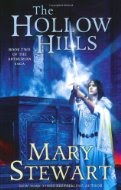
The Hollow Hills
I had been reading The Hollow Hills by Mary Stewart, the second book in her acclaimed Arthurian saga so I decided I would take it along on my trip to my son's 2-day college orientation. It was a good choice as it certainly gave me something to do during the down times in the evening. I had hoped to have more down time between lectures to read on it but there wasn't too much time. Instead I skipped a couple of whole sessions on such intriguing subjects as how to handle the stress of your child leaving for college. I think my wife and I have that under control...thus a bit more reading time.
The only bad thing about bringing this book along on the trip was that it's a great looking trade paperback and I had hoped to keep it looking nice for my bookshelf. I almost made it...except for a leaky water bottle on the very last session. Not too bad though, only a small section at the bottom of the last 20 pages or so now has that water/wrinkle look.
The book itself was mostly very good. A few sections dragged a bit. I've read quite a few versions of the Arthurian legend including those by TH White, Bernard Cornwell, and Stephen R. Lawhead. Still on my shelf is Jack Whyte's huge 8 volume set which probably won't get read for at least 5 more years. I like Ms Stewart's take on it though, fairly straight-forward story with lots of political intrigue. Merlin is her narrator which is as it should be in my opinion. Who else really knows everything that is going on here? Looking forward to number three in the series, later this year.
The only bad thing about bringing this book along on the trip was that it's a great looking trade paperback and I had hoped to keep it looking nice for my bookshelf. I almost made it...except for a leaky water bottle on the very last session. Not too bad though, only a small section at the bottom of the last 20 pages or so now has that water/wrinkle look.
The book itself was mostly very good. A few sections dragged a bit. I've read quite a few versions of the Arthurian legend including those by TH White, Bernard Cornwell, and Stephen R. Lawhead. Still on my shelf is Jack Whyte's huge 8 volume set which probably won't get read for at least 5 more years. I like Ms Stewart's take on it though, fairly straight-forward story with lots of political intrigue. Merlin is her narrator which is as it should be in my opinion. Who else really knows everything that is going on here? Looking forward to number three in the series, later this year.
Monday, April 12, 2010
The Alchemist
Most of the time I already know what the next 4 or 5 books I'll be reading are. I just sort of plan things that way. But this time I decided to just see what popped off my shelves. Interestingly, it was The Alchemist, by Donna Boyd. I had purchased this book several years ago when I needed just one more book to hit the Amazon free shipping threshold. It looked good on the web page and it looked good on my shelf but my fantasy fiction tends towards series and thus a stand-alone book such as this one often gets forgotten. So this was my opportunity.
And it was a fabulous read! The premise is that a charismatic man enters a therapist's office in New York City after having committed one of the most hi-vis murders in history. But he claims he is not of our modern era, instead he is an immortal, born into ancient Egypt and going by the name "Han". He proceeds to tell her the story of his long life, and indeed, this is the vast majority of the novel. Han was a student of the House of Ra, where the secrets of magic and science, alchemy and engineering are learned. Along with his two best friends and co-students, Akan (a boy) and Nefar (a girl), they discover that the power than can jointly wield has unsurpassed potential. They discover the secrets of immortality and though they know they have the power to be gods, they desire to use their power to bring about a better world. But of course when you have three such great friends, that tends to be one too many, particularly when one is of the opposite sex. Their ideal world never comes to be because of their inability to resist their own power, jealousies, rivalries, and thick-headed stubbornness.
The plot was filled with intrigue and open-ended possibilities. I had no clue as to how it would turn out; I just knew I wanted to know what happened next. That for me is the mark of a great read. Ms Boyd used a style in her story telling which is very picturesque, almost poetic even, that was very refreshing. That sort of thing has turned me off before but this time it was absolutely the right way to go. It made Han’s story even more believable because it was like this man really had lived through several centuries, really had been near the seat of power in different cultures, etc. Han has a “voice” here like few other novels I’ve read. Interestingly, Ms Boyd writes under several different pseudonyms, presumably for different genres or sub genres, including romance and I can see that influence here in this work. If there is one thing I wished for in this book it would be for more of the historical eras to be fleshed out. Instead of skipping 2,000 years, I would have loved to read about Han’s adventures during that time…but then I suppose the real story would have gotten lost in the sheer size of such a novel (or series). Anyway, this book was a very pleasant surprise; perhaps I should consider more random acts of reading in the future.
“The Man Who Came Early,” was the next entry in The Best Time Travel Stories of the 20th Century. Written by Poul Anderson, another of the great science fiction writers of the “Golden Age” I was a little worried about this one. I had struggled through a novel of his many years ago when I was too young to grasp it’s concepts and thus I found it simply boring. I’m glad I’ve had an opportunity to revise my opinion of him now because this story is probably the best of the batch so far. This time the story begins in the past, in Iceland, and a time traveler from present day, who happens to be a US Army soldier/engineer assigned to Reykjavik base in Iceland appears, having been struck by lightning in his time. No other explanation of time travel is attempted which lets the story happen. Despite the soldier’s assumption that his knowledge and experience would lead him to greatly contribute to the local society of the past, he soon discovers that he is almost helpless. The story is at once comical, intriguing, educational (Mr Anderson certainly did his homework on that era in Iceland), and sad. This one’s a keeper.
Next up: The Sculpter by newcomer, Gregory Funaro.
And it was a fabulous read! The premise is that a charismatic man enters a therapist's office in New York City after having committed one of the most hi-vis murders in history. But he claims he is not of our modern era, instead he is an immortal, born into ancient Egypt and going by the name "Han". He proceeds to tell her the story of his long life, and indeed, this is the vast majority of the novel. Han was a student of the House of Ra, where the secrets of magic and science, alchemy and engineering are learned. Along with his two best friends and co-students, Akan (a boy) and Nefar (a girl), they discover that the power than can jointly wield has unsurpassed potential. They discover the secrets of immortality and though they know they have the power to be gods, they desire to use their power to bring about a better world. But of course when you have three such great friends, that tends to be one too many, particularly when one is of the opposite sex. Their ideal world never comes to be because of their inability to resist their own power, jealousies, rivalries, and thick-headed stubbornness.
The plot was filled with intrigue and open-ended possibilities. I had no clue as to how it would turn out; I just knew I wanted to know what happened next. That for me is the mark of a great read. Ms Boyd used a style in her story telling which is very picturesque, almost poetic even, that was very refreshing. That sort of thing has turned me off before but this time it was absolutely the right way to go. It made Han’s story even more believable because it was like this man really had lived through several centuries, really had been near the seat of power in different cultures, etc. Han has a “voice” here like few other novels I’ve read. Interestingly, Ms Boyd writes under several different pseudonyms, presumably for different genres or sub genres, including romance and I can see that influence here in this work. If there is one thing I wished for in this book it would be for more of the historical eras to be fleshed out. Instead of skipping 2,000 years, I would have loved to read about Han’s adventures during that time…but then I suppose the real story would have gotten lost in the sheer size of such a novel (or series). Anyway, this book was a very pleasant surprise; perhaps I should consider more random acts of reading in the future.
“The Man Who Came Early,” was the next entry in The Best Time Travel Stories of the 20th Century. Written by Poul Anderson, another of the great science fiction writers of the “Golden Age” I was a little worried about this one. I had struggled through a novel of his many years ago when I was too young to grasp it’s concepts and thus I found it simply boring. I’m glad I’ve had an opportunity to revise my opinion of him now because this story is probably the best of the batch so far. This time the story begins in the past, in Iceland, and a time traveler from present day, who happens to be a US Army soldier/engineer assigned to Reykjavik base in Iceland appears, having been struck by lightning in his time. No other explanation of time travel is attempted which lets the story happen. Despite the soldier’s assumption that his knowledge and experience would lead him to greatly contribute to the local society of the past, he soon discovers that he is almost helpless. The story is at once comical, intriguing, educational (Mr Anderson certainly did his homework on that era in Iceland), and sad. This one’s a keeper.
Next up: The Sculpter by newcomer, Gregory Funaro.
Tuesday, March 30, 2010
Beyond the Shadows
Last night I was able to finish up Beyond the Shadows by Brent Weeks, the concluding volume in the "Night Angel" trilogy of fantasy novels. Mr Weeks continues to be a major new talent in the fantasy genre in my opinion, but I felt this one to be a step below the second and two steps below the first...if that makes sense.
The first book of the trilogy, The Way of Shadows, was extremely good; a well-constructed novel that left me breathless with anticipation for the next two books. I think what I like about it was the way the protagonist began as just a young boy in the worst of circumstances and through a series of circumstances, luck, and plain hard work, rose to become a master of his profession (assassination). Along the way he grew as a character, coming to question the very morality of what he was doing, even though his targets ("deaders") deserved it. The second book continued and he grew in strength and power until now we reach the third book...and it seemed like the author needed to re-invent where he was going with the trilogy. The crux of the problem, I think, is that his protagonist has grown too powerful and has few vulnerabilities left. How can you raise suspense with the reader when the hero can fight better than anybody, has powers like invisibility, fast healing, and, oh yes, he's immortal. Every time he dies he is resurrected.
So here we are in the third book with an un-killable protagonist. He does discover that there are dire consequences to his resurrections...every time he comes back, somebody else, an innocent, dies. And usually its somebody he knows. OK, that's a problem so now he has to be careful. Most of the novel takes place at a larger scale than the first two books; i.e. we now learn far more about the world, itself, the major powers, and the ever-present power struggle itself. The battles are no longer one-on-one (or one against 100) but rather on a more epic scale of armies battling one another. Some of the minor characters from book 2 are fleshed out more now but I didn't really care about them as they seemed extraneous somehow. I wanted to see what was happening with the major characters. And several times the pacing of the action was interrupted with lengthy descriptive passages that just served to ruin the flow. I'm being hard on Mr Weeks here because the first book really showed what awesome talent he has. In fact, I suspect the pacing issues may have arisen from editor/publisher requirements on length. This volume is long as it is at almost 700 pages but I suspect if given free rein, the author would have given us a more complete experience. Still, having said all that, I still look forward to more of this author's work.
The next short story in The Best Time Travel Stories of the 20th Century was "I'm Scared," by Jack Finney, best known probably for writing the original "Invasion of the Body Snatchers" story. As with much speculative fiction of the 1950's, the emphasis is not so much on technological explanations or scientific theories but rather on mood and setting. The story is told in the first person POV, as the protagonist tells how he has come across a theory that as time goes on, there are more and more instances of time anomolies occurring. He gives several examples such as a lady who is visited by a stray dog for several days and then two years later becomes the owner of that same dog as a pup. Another example involves a man from the turn of the century (~1900) that appears in the middle of a busy street in the present day and, bewildered, gets run over by a cab. His conclusion is interesting: as time goes on we are more and more interested in escaping our current lives (yearning for the good ol days, back when life was worth living, etc) that the result is more and more disruption in the flow of time. Where this leads is speculation at best but I wonder what Mr Finney would think about that same concept now in 2010, when even more of us wish for a simpler time...
Next up, On The Grid, by Scott Huler.
The first book of the trilogy, The Way of Shadows, was extremely good; a well-constructed novel that left me breathless with anticipation for the next two books. I think what I like about it was the way the protagonist began as just a young boy in the worst of circumstances and through a series of circumstances, luck, and plain hard work, rose to become a master of his profession (assassination). Along the way he grew as a character, coming to question the very morality of what he was doing, even though his targets ("deaders") deserved it. The second book continued and he grew in strength and power until now we reach the third book...and it seemed like the author needed to re-invent where he was going with the trilogy. The crux of the problem, I think, is that his protagonist has grown too powerful and has few vulnerabilities left. How can you raise suspense with the reader when the hero can fight better than anybody, has powers like invisibility, fast healing, and, oh yes, he's immortal. Every time he dies he is resurrected.
So here we are in the third book with an un-killable protagonist. He does discover that there are dire consequences to his resurrections...every time he comes back, somebody else, an innocent, dies. And usually its somebody he knows. OK, that's a problem so now he has to be careful. Most of the novel takes place at a larger scale than the first two books; i.e. we now learn far more about the world, itself, the major powers, and the ever-present power struggle itself. The battles are no longer one-on-one (or one against 100) but rather on a more epic scale of armies battling one another. Some of the minor characters from book 2 are fleshed out more now but I didn't really care about them as they seemed extraneous somehow. I wanted to see what was happening with the major characters. And several times the pacing of the action was interrupted with lengthy descriptive passages that just served to ruin the flow. I'm being hard on Mr Weeks here because the first book really showed what awesome talent he has. In fact, I suspect the pacing issues may have arisen from editor/publisher requirements on length. This volume is long as it is at almost 700 pages but I suspect if given free rein, the author would have given us a more complete experience. Still, having said all that, I still look forward to more of this author's work.
The next short story in The Best Time Travel Stories of the 20th Century was "I'm Scared," by Jack Finney, best known probably for writing the original "Invasion of the Body Snatchers" story. As with much speculative fiction of the 1950's, the emphasis is not so much on technological explanations or scientific theories but rather on mood and setting. The story is told in the first person POV, as the protagonist tells how he has come across a theory that as time goes on, there are more and more instances of time anomolies occurring. He gives several examples such as a lady who is visited by a stray dog for several days and then two years later becomes the owner of that same dog as a pup. Another example involves a man from the turn of the century (~1900) that appears in the middle of a busy street in the present day and, bewildered, gets run over by a cab. His conclusion is interesting: as time goes on we are more and more interested in escaping our current lives (yearning for the good ol days, back when life was worth living, etc) that the result is more and more disruption in the flow of time. Where this leads is speculation at best but I wonder what Mr Finney would think about that same concept now in 2010, when even more of us wish for a simpler time...
Next up, On The Grid, by Scott Huler.
Sunday, February 21, 2010
Shadow's Edge
It's seems to have taken me longer than normal to complete the reading of Shadow's Edge by Brent Weeks. I actually began reading this second book in the "Night Angel" trilogy last week on Saturday as I drove to a neighboring state to visit my parents for the weekend. That may have lessened my reading time somewhat but mostly I blame the Winter Olympics. We're big Olympics viewers, especially the winter games, and this past week has seen the whole family gathered in the TV room for hours on end witnessing some of the best sports drama I've seen in quite a while. So, yes, my reading time suffered. This book is almost 650 pages long though so I don't really feel too bad.
The plot picks up right after the first book ended, with our hero, Kylar, now having decided to give up the "wetboy" (assassin) life in order to preserve his sanity and pursue a more normal life with his childhood sweetheart. But, of course, that won't be so simple, as another friend from his young days shows up and informs Kylar that Logan, the heir to the thrown is alive after all and imprisoned in a horrible place. Only a wetboy of Kylar's skills can get him out. Throw in to the mix the arch enemy and father of Kylar's major nemesis in book one, the "Godking" that is bent on conquering neighboring lands and we have the making of a great fantasy story. But that's not all as several intriguing subplots flesh out the story including that of Vi, a female wetboy of great talent but questionable loyalty.
I admit to being a bit scared to start reading this one. The first book in the trilogy, The Way of Shadows, was among my all time favorite fantasy novels and I dreaded what so often happens...a major let down where the second book serves merely as a bridge to get to the third and final climactic book. Not so this time. There were a few points where I thought the plot dragged or where one of the characters in a subplot wasn't properly fleshed out, but overall, this was a very good read. And I think the book can largely stand alone; i.e. it has its own beginning, middle, and end (as long as you ignore the last paragraph which serves to setup an intriguing third book). I'll get to that third book pretty soon, but after the Olympics are complete.
"The Alibi" was the next entry in Jeffrey Archer's Cat O'Nine Tales collection of short stories. This one was a letdown from previous stories. Just not much to it other than the criminal using conjugal visits to set-up his alibi for additional petty crimes. It was interesting the way it worked but perhaps I am getting too many of these stories to make them stand out anymore. Only a few left though so we'll see how it goes.
Next up: time for another Louis L'Amour western: Hanging Woman Creek. Shouldn't take me a whole week this time.
The plot picks up right after the first book ended, with our hero, Kylar, now having decided to give up the "wetboy" (assassin) life in order to preserve his sanity and pursue a more normal life with his childhood sweetheart. But, of course, that won't be so simple, as another friend from his young days shows up and informs Kylar that Logan, the heir to the thrown is alive after all and imprisoned in a horrible place. Only a wetboy of Kylar's skills can get him out. Throw in to the mix the arch enemy and father of Kylar's major nemesis in book one, the "Godking" that is bent on conquering neighboring lands and we have the making of a great fantasy story. But that's not all as several intriguing subplots flesh out the story including that of Vi, a female wetboy of great talent but questionable loyalty.
I admit to being a bit scared to start reading this one. The first book in the trilogy, The Way of Shadows, was among my all time favorite fantasy novels and I dreaded what so often happens...a major let down where the second book serves merely as a bridge to get to the third and final climactic book. Not so this time. There were a few points where I thought the plot dragged or where one of the characters in a subplot wasn't properly fleshed out, but overall, this was a very good read. And I think the book can largely stand alone; i.e. it has its own beginning, middle, and end (as long as you ignore the last paragraph which serves to setup an intriguing third book). I'll get to that third book pretty soon, but after the Olympics are complete.
"The Alibi" was the next entry in Jeffrey Archer's Cat O'Nine Tales collection of short stories. This one was a letdown from previous stories. Just not much to it other than the criminal using conjugal visits to set-up his alibi for additional petty crimes. It was interesting the way it worked but perhaps I am getting too many of these stories to make them stand out anymore. Only a few left though so we'll see how it goes.
Next up: time for another Louis L'Amour western: Hanging Woman Creek. Shouldn't take me a whole week this time.
Monday, February 1, 2010
The Way of Shadows
The second novel I completed during my trip last week was Brent Week's The Way of Shadows. I'd been looking forward to this one for almost a year having read many good things about it and the entire "Night Angels" trilogy. If I had simply seen this one in the book store I might only have picked it up for my teenage son based on the cover art; it looks like one step away from a comic book cover and very similar to the myriads of teen vampire romancy things that have taken over the book stores lately (not that I'm judging; I dislike those who pass judgement on something they haven't read). But this trilogy, the first to be published by Mr Weeks, is often mentioned among the top of lists shared by people whose tastes best match mine. He has earned a reputation among the best of the "new" fantasy writers and I will do nothing here to alter that prestigious notoriety.
The story begins with some very dark scenes concerning street urchins and the horrible conditions in which they live in this fantasy world. The main character, Azoth, only a child at this point, witnesses brutal muggings, rape, sodomy, etc. and is forced to follow the law of the local bully, named "Rat". But our hero is made of stern stuff and consciously decides he won't stand for such a life; he needs to be in control and never let such bullies dominate him again. So he apprentices himself to the one man he regards as the most in-control person he has ever known, a master assassin, known as a "wetboy" in this universe. The rest of the novel depicts his training and beyond, examining how his background leads him to his fateful decisions. Just as Azoth's training progresses and he transforms into Kylar Stern so does our understanding of just what is really happening here.
So far, reading what I've described, you would probably conclude this is a rather typical formula-driven fantasy novel. But the way the intrigue unfolds here is utterly amazing. Nobody seems to be who you think they are; I found this story to be completely unpredictable and yet very well constructed. Loyalties are interchangeable and questions of good and evil are plentiful. It's no small task for a writer to develop his main character as an assassin, have innocents perish, and yet expect the reader to maintain a positive attitude towards him. But Mr Weeks pulls it off brilliantly. It doesn't hurt that Mr Weeks is one of the best writers of fight scenes out there, well choreographed and exciting and yet not overdone. All of the writing for that matter was crisp and clean and served to drive the story forward at a healthy pace. Truly an outstanding result for a first novel, the best fantasy I've read in a year since Patrick Rothfuss' The Name of the Wind, my all time favorite.
As always between novels, I've completed another short story, the next in Jeffrey Archer's Cat O'Nine Tales collection. "The Wisdom of Solomon" is another good one, and one of the best twist endings I've read in a long time by any author. It concerns a young man who marries a woman who has had three previous marriages (and divorces). Predictably, after a year she wants her fourth divorce and through good lawyers, a sympathetic judge, and an incredible display of how to wear down your opponant, is poised to gain virtually all of her soon-to-be ex-husband's wealth. It is hard not to divulge the twist at the end but I will say she gets what she deserves. This is one of the three tales in the collection that was not told to the author during his incarceration but rather after his release. Doesn't matter though, it's still done in an "as told to" style.
Next up, the novel I bought at the airport when I had run out of reading material on my trip: Cormac McCarthy's The Road.
The story begins with some very dark scenes concerning street urchins and the horrible conditions in which they live in this fantasy world. The main character, Azoth, only a child at this point, witnesses brutal muggings, rape, sodomy, etc. and is forced to follow the law of the local bully, named "Rat". But our hero is made of stern stuff and consciously decides he won't stand for such a life; he needs to be in control and never let such bullies dominate him again. So he apprentices himself to the one man he regards as the most in-control person he has ever known, a master assassin, known as a "wetboy" in this universe. The rest of the novel depicts his training and beyond, examining how his background leads him to his fateful decisions. Just as Azoth's training progresses and he transforms into Kylar Stern so does our understanding of just what is really happening here.
So far, reading what I've described, you would probably conclude this is a rather typical formula-driven fantasy novel. But the way the intrigue unfolds here is utterly amazing. Nobody seems to be who you think they are; I found this story to be completely unpredictable and yet very well constructed. Loyalties are interchangeable and questions of good and evil are plentiful. It's no small task for a writer to develop his main character as an assassin, have innocents perish, and yet expect the reader to maintain a positive attitude towards him. But Mr Weeks pulls it off brilliantly. It doesn't hurt that Mr Weeks is one of the best writers of fight scenes out there, well choreographed and exciting and yet not overdone. All of the writing for that matter was crisp and clean and served to drive the story forward at a healthy pace. Truly an outstanding result for a first novel, the best fantasy I've read in a year since Patrick Rothfuss' The Name of the Wind, my all time favorite.
As always between novels, I've completed another short story, the next in Jeffrey Archer's Cat O'Nine Tales collection. "The Wisdom of Solomon" is another good one, and one of the best twist endings I've read in a long time by any author. It concerns a young man who marries a woman who has had three previous marriages (and divorces). Predictably, after a year she wants her fourth divorce and through good lawyers, a sympathetic judge, and an incredible display of how to wear down your opponant, is poised to gain virtually all of her soon-to-be ex-husband's wealth. It is hard not to divulge the twist at the end but I will say she gets what she deserves. This is one of the three tales in the collection that was not told to the author during his incarceration but rather after his release. Doesn't matter though, it's still done in an "as told to" style.
Next up, the novel I bought at the airport when I had run out of reading material on my trip: Cormac McCarthy's The Road.
Wednesday, December 30, 2009
Unicorn Point
Hey I made it! I wasn't sure if I was going to complete this last book before the end of the year or not...but I did, and with a whole day to spare! Unicorn Point is the 6th and final book of Piers Anthony's "Apprentice Adept" series. Or so I thought. In my rush to wrap up trilogies and other series this month, I hadn't realized that there is actually a 7th book in this series. I don't own it but have seen it in the book store in years past. Not so suprising that I hadn't realized it though when you consider that Piers Anthony is an extremely prolific author with 140 books published to date. I've been reading him since I was a teenager, many moons ago and my database tells me this is the 63rd Piers Anthony book I've read. Wowzer.
Mr Anthony is somewhat infamous for cramming 6-7 novels in each of his "trilogies". Many people think the first three make a fine trilogy and then he proceeds to write more and thus ruin the series. His Xanth series alone started as a trilogy and is still going strong after 34 books. I tend to agree but am such a completest that I feel obligated to read the entire series. This particular series, the "Apprentice Adept" series is among my favorite, expecially the first three. The concept is very cool: a world that has a fantasy region called "Phaze" as well as a science region called "Proton." Magic works in Phaze whereas Proton is very science fictiony. Turns out the two regions were split from a single region sometime in the past and even the people have duplicates in the other region. Thus a magical "adept" in Phaze has a corresponding citizen or serf in Proton. But when one person accidentally enters the other zone...well you can imagine what sorts of chaos might develop.
This is definitely one of Mr Anthony's series that should have been limited to three books. Those first three novels, beginning with Split Infinity formed a tightly woven and complete story with well developed characters and compelling plot. They remain among my favorite fantasy novels. However, his attempt at a follow-on trilogy largely fails in my opinion. The new characters are mostly lifeless, and very similar to one another. They even think the same way and have the same attitudes (something I've noticed for many of this author's characters). The plot is overly complicated and confusing making the entire reading experience an onerous one. There are just enough intriguing parts to keep me on the hook and continuing to the next novel but overall I wished the author had pursued other stories. That probably explains why it took me 2 1/2 years between reading book 5 and book 6. This book, Unicorn Point is divided into 18 chapters, each with a different point of view character. That basically turns the book into 18 seperate vignettes that are intended to bring the entire story together. Instead it seperates the story and further complicates it. Take my advice and stop after the first three books in this series.
Next up: time to stop completing unfinished series and start fresh stories. I'm not sure what I'll chose to start the new year with but it'll be exciting to browse my shelves (exactly 300 books still to be read) and come up with the next entry. Tomorrow...the much anticipated (at least by me) TopDragon book awards!
Mr Anthony is somewhat infamous for cramming 6-7 novels in each of his "trilogies". Many people think the first three make a fine trilogy and then he proceeds to write more and thus ruin the series. His Xanth series alone started as a trilogy and is still going strong after 34 books. I tend to agree but am such a completest that I feel obligated to read the entire series. This particular series, the "Apprentice Adept" series is among my favorite, expecially the first three. The concept is very cool: a world that has a fantasy region called "Phaze" as well as a science region called "Proton." Magic works in Phaze whereas Proton is very science fictiony. Turns out the two regions were split from a single region sometime in the past and even the people have duplicates in the other region. Thus a magical "adept" in Phaze has a corresponding citizen or serf in Proton. But when one person accidentally enters the other zone...well you can imagine what sorts of chaos might develop.
This is definitely one of Mr Anthony's series that should have been limited to three books. Those first three novels, beginning with Split Infinity formed a tightly woven and complete story with well developed characters and compelling plot. They remain among my favorite fantasy novels. However, his attempt at a follow-on trilogy largely fails in my opinion. The new characters are mostly lifeless, and very similar to one another. They even think the same way and have the same attitudes (something I've noticed for many of this author's characters). The plot is overly complicated and confusing making the entire reading experience an onerous one. There are just enough intriguing parts to keep me on the hook and continuing to the next novel but overall I wished the author had pursued other stories. That probably explains why it took me 2 1/2 years between reading book 5 and book 6. This book, Unicorn Point is divided into 18 chapters, each with a different point of view character. That basically turns the book into 18 seperate vignettes that are intended to bring the entire story together. Instead it seperates the story and further complicates it. Take my advice and stop after the first three books in this series.
Next up: time to stop completing unfinished series and start fresh stories. I'm not sure what I'll chose to start the new year with but it'll be exciting to browse my shelves (exactly 300 books still to be read) and come up with the next entry. Tomorrow...the much anticipated (at least by me) TopDragon book awards!
Saturday, December 26, 2009
Inkdeath
Here's hoping everybody is having a great end-of-the-year holiday season. I know I'm enjoying some time off and spending time with my family. My reading time is actually suffering some due to all of the other activities this time of year. Nevertheless, I did manage to find time to complete my reading of the third book of the Inkheart trilogy by Cornelia Funke, Inkdeath.
I confess to stalling quite a bit before getting around to this one. I quite enjoyed the first book in the series but felt the second one, Inkspell dragged somewhat. It was probably a necessary evil because Ms Funke did not take the easy way out and simply rewrite another version of the first book. She greatly expanded the "Inkheart" universe and the number of characters and subplots jumped tremendously. Now, here in the third book, I was afraid the whole thing would fail to wrap up in a satisfactory manner. I happily discovered that not to be the case and even though I didn't enjoy it as much as the first book, it was still a good one.
There are numerous characters in this book. I read somewhere that there are 114 of them which makes things hard to keep track of. Fortunately, an appendix is included which contains a short blurb about each one and even some reminders of their roles in the previous novels. I referred to that quite often, looking up several characters more than once to get that "oh yeah" moment. The plot moved along pretty well in this novel with lots of jumping around among the many points of view. I was, however, disappointed in the vastly diminished roles of Meggie and Farid, both major characters in the first book. Mo has a major role once again, taking on the persona of a Robin Hood sort of figure called the Bluejay.
This trilogy has really evolved over the course of the three books, becoming darker as we move along. The attraction for me, and what I believe makes this a good trilogy for youngsters, is the idea of being able to bring characters out of fictional stories by reading, as well as changing the very reality of the story you are living in by writing new scenes. That's just cool and gets to the very heart of young people's imaginations. On a deeper level, I suppose, it addresses the idea of predestination vs. changing your own future through your actions. I tend to take it more at the first level and just let my imagination go.
I commented to Anita, who wrote a comment here a couple of blog entries ago, and whose blog I also follow, that I think these books are best when read aloud to the whole family, particularly if you can do many different voices. I used to do that with my family (when my kids were young) with classics like Narnia, Harry Potter, etc. That sort of setting really brings the story alive and lets you sink into the characters. I really miss those evenings at our house.
I also completed the last short story in the L'Amour collection but I will do a seperate blog about that in a couple of days since it is the last story. Next novel, and last of the year is finishing up yet another series which I began years ago: Unicorn Point by Piers Anthony.
I confess to stalling quite a bit before getting around to this one. I quite enjoyed the first book in the series but felt the second one, Inkspell dragged somewhat. It was probably a necessary evil because Ms Funke did not take the easy way out and simply rewrite another version of the first book. She greatly expanded the "Inkheart" universe and the number of characters and subplots jumped tremendously. Now, here in the third book, I was afraid the whole thing would fail to wrap up in a satisfactory manner. I happily discovered that not to be the case and even though I didn't enjoy it as much as the first book, it was still a good one.
There are numerous characters in this book. I read somewhere that there are 114 of them which makes things hard to keep track of. Fortunately, an appendix is included which contains a short blurb about each one and even some reminders of their roles in the previous novels. I referred to that quite often, looking up several characters more than once to get that "oh yeah" moment. The plot moved along pretty well in this novel with lots of jumping around among the many points of view. I was, however, disappointed in the vastly diminished roles of Meggie and Farid, both major characters in the first book. Mo has a major role once again, taking on the persona of a Robin Hood sort of figure called the Bluejay.
This trilogy has really evolved over the course of the three books, becoming darker as we move along. The attraction for me, and what I believe makes this a good trilogy for youngsters, is the idea of being able to bring characters out of fictional stories by reading, as well as changing the very reality of the story you are living in by writing new scenes. That's just cool and gets to the very heart of young people's imaginations. On a deeper level, I suppose, it addresses the idea of predestination vs. changing your own future through your actions. I tend to take it more at the first level and just let my imagination go.
I commented to Anita, who wrote a comment here a couple of blog entries ago, and whose blog I also follow, that I think these books are best when read aloud to the whole family, particularly if you can do many different voices. I used to do that with my family (when my kids were young) with classics like Narnia, Harry Potter, etc. That sort of setting really brings the story alive and lets you sink into the characters. I really miss those evenings at our house.
I also completed the last short story in the L'Amour collection but I will do a seperate blog about that in a couple of days since it is the last story. Next novel, and last of the year is finishing up yet another series which I began years ago: Unicorn Point by Piers Anthony.
Wednesday, December 2, 2009
Kushiel's Avatar
During my lunch break today I finished up the final book in Jacqueline Carey's "Kushiel's Legacy" trilogy. Kushiel's Avatar follows the first book, Kushiel's Dart and the second, Kushiel's Chosen. This is a relatively long book, coming it at 750 paperback pages and does a fine job of concluding the trilogy. The heroine, Phedre, has grown from a young girl to a mature woman through this series and we get to experience her world and all of the complex intrigue included therein right along with her.Ten years have passed since the end of the second book and Phedre has settled into a nice life with her consort Joscelin. She still takes on clients as an anguisette but now only three per year. Life is good. The only thing that still haunts her is the fate of her childhood friend, Hyacinth, who had sacrificed himself back in the first book to suffer the curse of being a perpetual apprentice to the Master of the Straits. Now when Phedre's nemesis, the beautiful Melisande contacts Phedre and begs her to go in search of her kidnapped son, Phedre makes a deal with her that will ultimately culminate in Hyacinth's release.
As in the previous novels in the trilogy, the tapestry of this world is vast and detailed. Essentially, it is an alternate Earth and we travel along with Phedra and her company of escorts, guardsmen, etc. from Europe to the Middle East and to northern and central Africa. Most of the place names are similar to ours so it is possible to decipher where they are going but I was very happy to have the map at the front of the book to refer to. Also, there are lots and lots of characters so the list of their names and relationships was welcome. This book is not for those easily offended by erotic scenes as there are several in here, one in particular which is extremely graphic but also very necessary to the plot. The protagonist, afterall, is bound by her gods to experience both pain and pleasure as a courtesan so that sort of thing does come up in the plot. Taken as a trilogy, this is a vast epic fantasy that is very enjoyable to read. I felt there were a few spots with too much description of scenery and a few too many stops along her journey that didn't seem to have much bearing on the plot. A little too long but enjoyable none-the-less. I plan to read the follow-on trilogy which focuses on the boy that had been kidnapped, and his life...but these books are so long that I will wait a while before beginning that series.
I was also able to complete another short story in the Louis L'Amour collection, The Strong Shall Live. "Hattan's Castle" was a bit different from what I'm used to but still quite enjoyable. It's told like a campfire story, lots of description about what happened but not much actual dialogue. It's the old story about a town in the Old West run by a bully that suddenly has to deal with a new man that challenges his leadership. There is an unexpected twist involved that makes this a cute tale but I won't spoil it for you. I continue to really like this collection.
Next up: Black Rain, a thriller novel by Graham Brown, part of the "Vine" program that allows me to read as-yet-unpublished bookss. This one will be published in January, 2010.
Tuesday, November 3, 2009
The Parched Sea
Yesterday, I enjoyed an unexpectedly long lunch period so was able to complete Troy Denning's The Parched Sea a full day ahead of schedule. This is the first book in "The Harper's" series, part of the Forgotten Realms milieu in the Dungeons and Dragons universe. A note about novels that are game tie-ins: I never expect them to be outstanding literature but I do expect them to be nice diverting entertainment, whisking me off to fantastical worlds and allowing me to excape my own reality. They usually fullfill that task although there are, of course, some exceptions. The Forgotten Realms setting has been better than most for me, especially the works of RA Salvatore although he occassionally misfires as well. The "Harpers" for those that don't know, are a semi-secret group of people devoted to good; i.e. helping people and causes that are in the best interest of others. The Harpers series is an open-ended subset of the greater Forgotten Realms setting, with each book of the 16 in the series being a stand alone novel and written by various authors. The Parched Sea is among the better Forgotten realms novels I've read. I was in a mood to read some relatively straight-forward fantasy, looking for old fashioned adventure and intrigue with powerful magic inserted here and there. This one fit the bill splendidly. The setting is the unforgiving desert of Anauroch on the planet of Faerun (well known to Forgotten Realms fans) The main protagonist is Ruha, a Bedine "witch" outcast that has been married off to another tribe as a way to build an alliance. Lander is the Harper of this novel and has been sent to the desert to thwart the Zhentarim plans to enslave the indigenous peoples of the region. Together they face numerous challenges and attempt to overcome the difficulties of the situation.
I always enjoy novels where ordinary people do extraordinary things even though that sometimes leads to formula writing. Here both main characters have to dig deep and Ruha, especially, is able to call on some awesome magic. But here's what makes this book better than most basic fantasy, especially game tie-ins: the magic can be awesome but it has to be used in unusual and unexpected ways. Tactics and strategy win the battle, not just superior firepower. Mr Denning is an experienced author, and knows the Realms well, as evidenced by his ability to deftly describe the overall setting for the uninitiated reader. I'm often skeptical of authors who began their careers as game designers, knowing they have plenty of creativity but worried that they are only hack writers, churning out plots without regard to characterization, etc. But Mr Denning transcends that typecasting and really succeeds with this story. The characters were multi-dimensional, the story was intriguing, the plot was paced well, and overall it was a very enjoyable read. I'm looking forward to reading more of The Harper's series soon, even though different authors/characters may lead to hits and misses.
Because of that long lunch break yesterday I was also able to begin the next collection of short stories. Louis L'Amour is famous for his western novels but he also wrote a fair number of short stories, bundled together in several different collections. The Strong Shall Live is the second of his western short story collections to be published and I was actually able to finish the first two entries yesterday. "The Strong Shall Live" is also the name of the first story in the collection and is a fairly typical L'Amour story about survival. The main character is forced to survive a trek across the empty West in search of water. The second entry, "One Night Stand" is quite a bit different. It concerns an actor who takes on the role of Wild Bill Hickock in order to stand down a punk gunfighter. This is a humerous story, not something Louis L'Amour is known for but nevertheless does well.
Next up: All the Rage a Repairman Jack novel by F. Paul Wilson.
Monday, September 28, 2009
Kushiel's Chosen

The third book that I read on my vacation journey was Jacqueline Carey's Kushiel's Chosen. That is, I read most of it during the trip but completed it this weekend. This is the second book in Ms Carey's first trilogy of the land of Terre D'Ange, following Kushiel's Dart. This is an adult fantasy novel, as is the series, and not really meant for those that blush at a hint of eroticism.
The main character, Phèdre nó Delaunay de Montrève, is a courtesan and spy and she uncovers a conspiracy of treason and murder that takes her on adventures to other contries accompanied by an intriguing cast of characters. Ultimately she faces her old foe, Melisande. I really enjoyed reading this novel, despite several factors that normally kill a story for me. First it has many many characters, all with names that are difficult to pronounce. Often when I read novels like that, I lose the thread of what is happening and to whom. Not this time. The world itself is a replica of our own Earth, at least the European and Mediterranean areas and I found that to be a solid anchor. Even though different names were used I could "typecast" a new character when they were introduced, associating them with our cultures and physical appearances. Ms Carey's writing is highly skilled and she writes in a style that seems to fit the type of story it is; i.e. sensual writing, almost poetic in some places as would befit a beautiful courtesan protagonist.
I also felt this was an unusually good story line and even though it is the middle book of a trilogy, it fits solidly into a greater whole and doesn't suffer from "'middle book" syndrome that befalls so many fantasy trilogies. I read the first book over a year ago and planned to read the third book sometime next year but now I'm thinking I'll be pushing that up to the next 3 months of this year. I just want to see what happens next and I want to surround myself with these characters once again.
The main character, Phèdre nó Delaunay de Montrève, is a courtesan and spy and she uncovers a conspiracy of treason and murder that takes her on adventures to other contries accompanied by an intriguing cast of characters. Ultimately she faces her old foe, Melisande. I really enjoyed reading this novel, despite several factors that normally kill a story for me. First it has many many characters, all with names that are difficult to pronounce. Often when I read novels like that, I lose the thread of what is happening and to whom. Not this time. The world itself is a replica of our own Earth, at least the European and Mediterranean areas and I found that to be a solid anchor. Even though different names were used I could "typecast" a new character when they were introduced, associating them with our cultures and physical appearances. Ms Carey's writing is highly skilled and she writes in a style that seems to fit the type of story it is; i.e. sensual writing, almost poetic in some places as would befit a beautiful courtesan protagonist.
I also felt this was an unusually good story line and even though it is the middle book of a trilogy, it fits solidly into a greater whole and doesn't suffer from "'middle book" syndrome that befalls so many fantasy trilogies. I read the first book over a year ago and planned to read the third book sometime next year but now I'm thinking I'll be pushing that up to the next 3 months of this year. I just want to see what happens next and I want to surround myself with these characters once again.
Subscribe to:
Posts (Atom)
Top 10 Books in no particular order (Well Known Authors)
- "The Stand" by Stephen King
- "Kane and Able" by Jeffrey Archer
- "The Killer Angels" by Michael Shaara
- "The Dark Elf Trilogy" by RA Salvatore
- "Name of the Wind" by Patrick Rothfuss
- "River God" by Wilbur Smith
- "Mortalis" by RA Salvatore
- "Ender's Game" by Orson Scott Card
- "Centennial" by James A Michener
- "The Repairman Jack" series by F. Paul Wilson
Top Books/ Series in no particular order (Lesser Known Authors)
- "The Sculpter" by Gregory Funaro
- "Power Down" by Ben Coes
- "Revolution at Sea Saga" by James L. Nelson
- "Black Rain" by Graham Brown
- "Top Producer" by Norb Vonnegut
- "Prairie" by Anna Lee Waldo
- "The Wild Blue" by W. Boyne & S Thompson
- "Unsolicited" series by Julie Kaewert
- "Freedom" by William Safire